An investment inventory is a working list of what you hold and where the evidence is. It gives you a starting point for later reviews, even when your information is incomplete.
For the first pass, aim for traceable entries. A short list you can verify is more useful than a polished total built from guesses.
Begin with a list of institutions
Write down the banks, brokers, fund providers and other institutions where you believe you hold investments. Ask each participating family member to check their own records. Mark an institution as “statement needed” until you have a source, rather than silently excluding it.
Work through one institution at a time. Record what the source actually covers so a partial export does not become a supposedly complete account inventory.
Use these fields for your first version
| Field | What to record |
|---|---|
| Owner | Person or entity shown in the source |
| Institution and reference | Provider plus a masked account or folio reference |
| Investment | Name and source-provided identifier, if available |
| Quantity | Reported units, or not applicable / unknown |
| Reported value | Amount, currency and the source’s own label |
| As-of date | Date represented by the holding or value |
| Source location | Where the original statement can be found |
| Review status | Checked, needs clarification or source missing |
Keep purchase cost separate from reported value if both are supplied. If the statement shows only one, do not fill the other by assumption.
What one entry could look like
Here is a fictional example: “Owner A — Example Fund — folio ending 4821 — 250 units — reported value ₹31,250 — as of 31 October 2026 — source: October statement — reviewed 3 November.”
The example’s value is invented. Its purpose is to show how a number becomes easier to check when it has an owner, a date and a source.
Resolve identity before totals
Similar investment names can refer to different holdings. Conversely, different files can describe the same holding. Check the account, folio and available identifier before deciding whether entries are separate.
If a consolidated statement and a provider statement overlap, retain both source references but count the underlying holding only once in a given dated view. Do not add several snapshots together to create a larger portfolio.
Review before saving
Compare names, owners, units, currency and dates with the original document. Check that every source row you intended to include has been considered. Flag unreadable figures instead of estimating them.
Keeping source documents is consistent with SEBI’s guidance on investment records.
How Punjii.com can help
Punjii’s private-beta work includes organising family owners and portfolios, with supported uploads passing through review before becoming confirmed holdings snapshots. The purpose of that review is to keep you involved in checking the extracted information and its ownership.
You do not need to reshape every source into a prescribed template: supported native documents and exports can enter the review workflow. Format support and extraction accuracy still need checking for your particular file. Do not assume every registrar or broker format is certified.
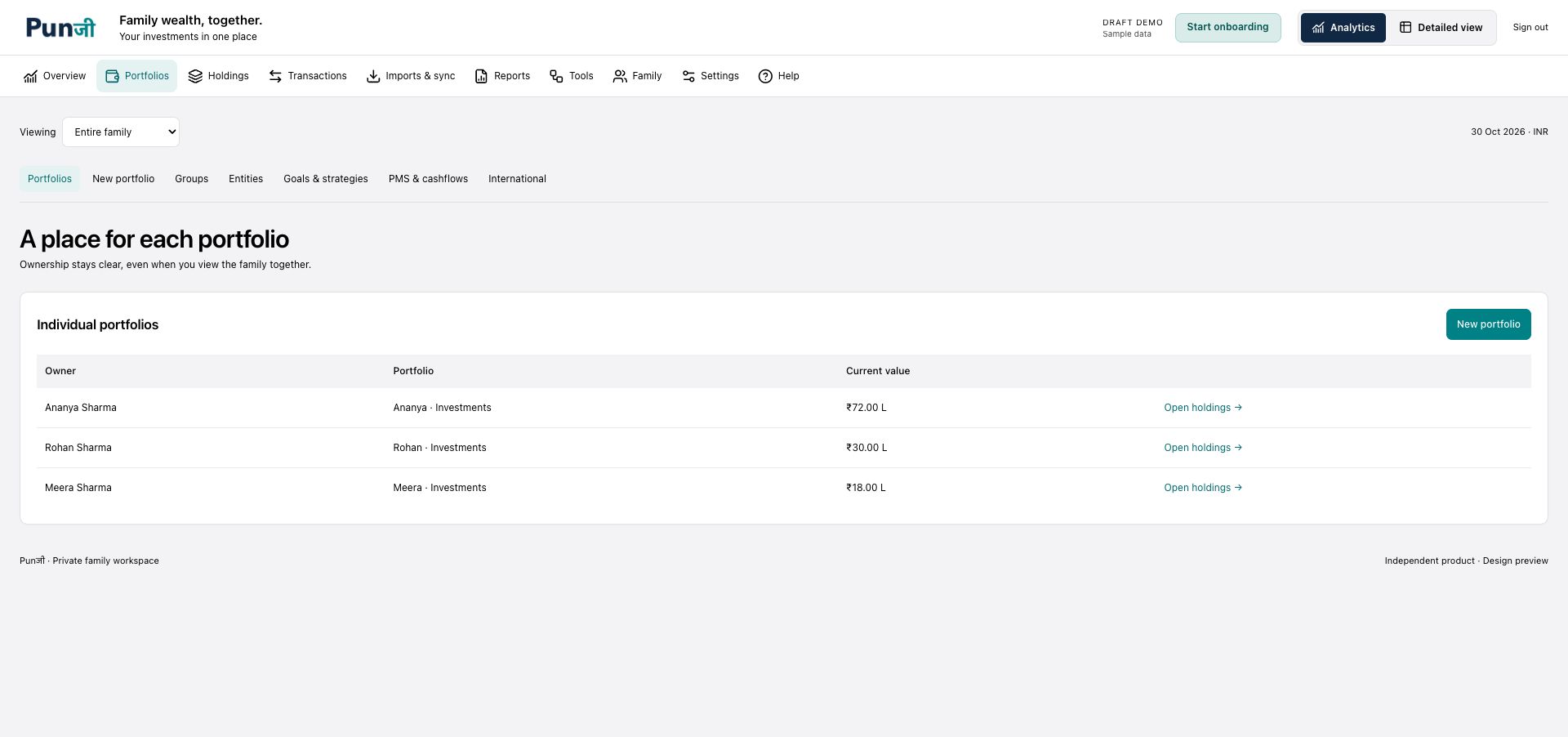
The public portfolio preview illustrates how ownership and portfolios can be separated. Its balances are sample values, not live imported account totals. Automatic account syncing remains unavailable.
Join the Punjii beta waitlist for availability and access updates. Private beta is opening in stages.
Finish with an honest coverage note
Write a one-line status such as “Two institutions checked; one statement outstanding; values dated 31 October.” That tells your future self what this inventory can support and what still needs attention.