“Our investments are worth ₹18 lakh” and “Our net worth is ₹18 lakh” sound similar. They can describe very different things.
The distinction matters whenever you review a financial dashboard. Before using a total to make a decision, establish what it includes, what it excludes and the date it represents.
Portfolio value describes a defined set of investments
For a household review, define portfolio value as the value of the investment holdings included in that particular view. Its scope might be one broker account, one person’s investments or a set of family portfolios.
The label alone does not tell you whether bank deposits, property or other assets are included. Read the scope and valuation basis. A total assembled from statements with different dates also needs that limitation made clear.
Net worth brings assets and debts together
Net worth is total assets minus total liabilities. It answers a broader question than the value of an investment account. Investor.gov explains this assets-minus-liabilities calculation.
A household worksheet might include investment holdings, bank balances and a supported estimate for a home, alongside the outstanding balances of loans and other debts. Set the household boundary first and count each asset or debt once.
A worked example
The following numbers are invented for explanation. They are not taken from the Punjii screenshot.
| Item | Illustrative amount |
|---|---|
| Investment portfolio | ₹18 lakh |
| Bank balances, outside that portfolio | ₹2 lakh |
| Home estimate | ₹60 lakh |
| Total assets | ₹80 lakh |
| Outstanding home loan | ₹35 lakh |
| Other outstanding debt | ₹1 lakh |
| Total liabilities | ₹36 lakh |
| Net worth | ₹44 lakh |
The investment portfolio is ₹18 lakh. Net worth is ₹44 lakh because the second calculation covers a wider set of assets and subtracts debts. Neither number tells you how much cash is immediately available.
Keep three other questions separate
How much can we access? A property estimate and a bank balance have different practical uses. Record access restrictions separately rather than treating every asset as ready cash.
How have the investments performed? A larger balance can reflect new contributions. A current value on its own does not establish investment returns.
How reliable is the figure? An estimate, an old statement and a recent confirmed balance deserve different labels. An unknown debt balance should remain unresolved until checked.
How Punjii.com can help
Punjii’s focus is bringing the family investment picture together. Its public Detailed view preview illustrates a way to inspect individual investments alongside a portfolio summary. That structure can help you ask what sits behind a headline number.
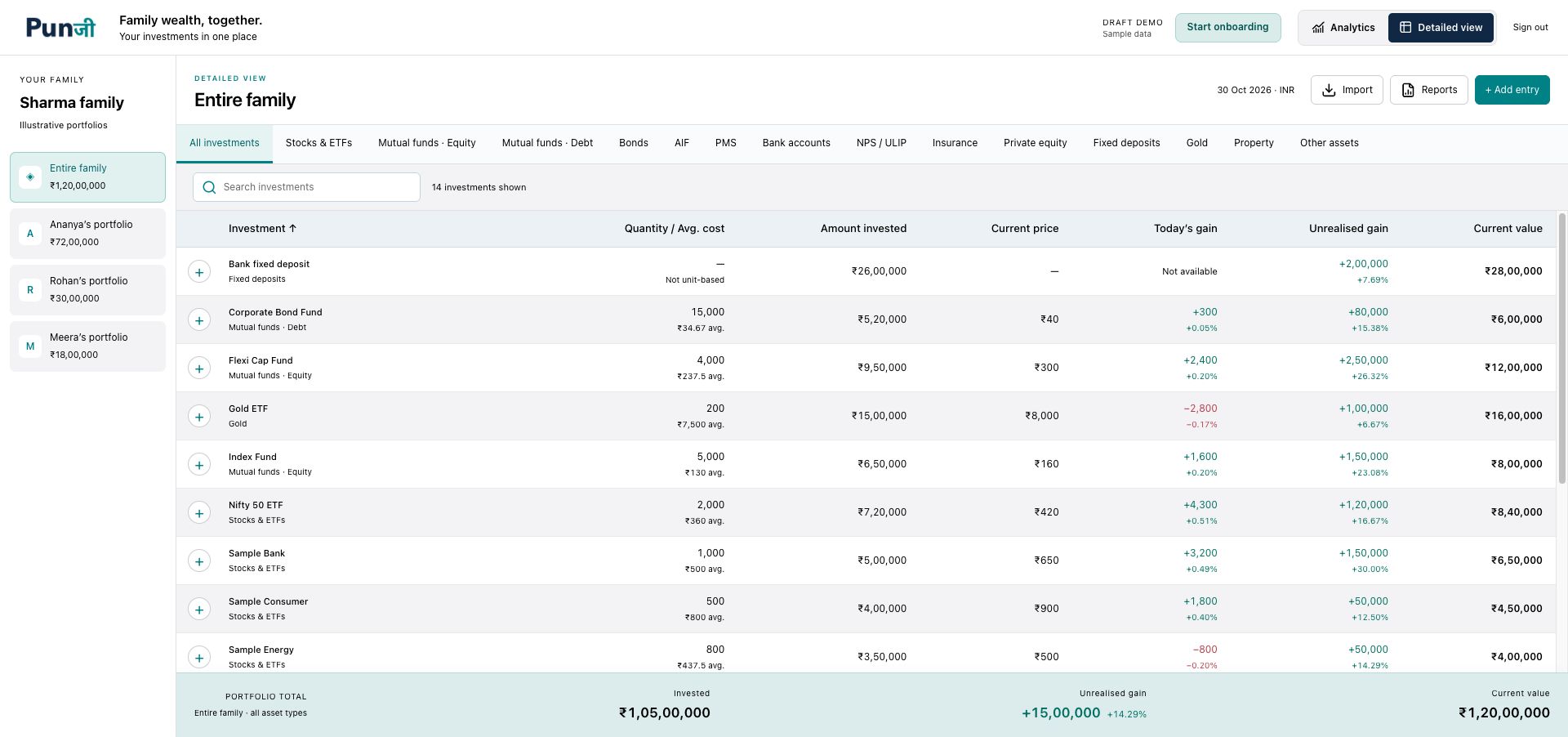
The preview’s figures, gains and prices are synthetic. They do not demonstrate a live valuation feed or a net-worth calculation for your household. Current private-beta reporting centres on selected reviewed holdings snapshots; it should not be treated as a complete statement of your assets and liabilities.
As you explore Punjii, keep a separate list of any assets and debts outside the investment records you have reviewed. This preserves the distinction between an organised investment view and a complete household balance sheet.
Join the Punjii beta waitlist for availability and access updates. Private beta is opening in stages.
What to check at your next review
Write the scope and date beside every total. Then ask: Are any assets missing? Have any holdings been counted twice? Are debts included? Those answers make the number more useful than the size of the number alone.